Elevation Changes Transform Cyclist Power Requirements and Alter Rankings During Mountain Stages of Major Tours
Written by Elena Wagner · Sep 16, 2026
Elevation Changes Transform Cyclist Power Requirements and Alter Rankings During Mountain Stages of Major Tours
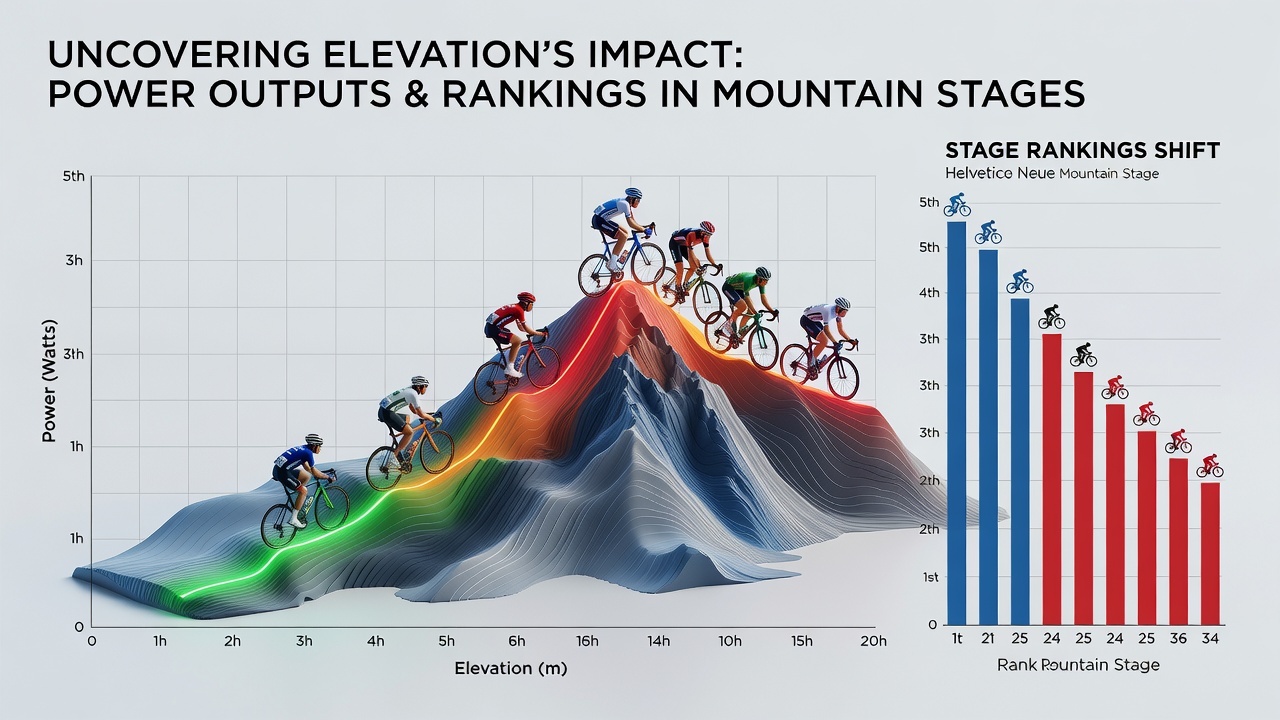
Professional cycling tours feature mountain stages where elevation gains force riders to sustain elevated power outputs, and these demands directly influence stage results along with overall classifications. Gradients above 6 percent require sustained efforts that shift the balance between pure power production and power-to-weight ratios, while riders who excel on climbs often gain decisive time advantages over flatter specialists.
Physics Behind Power Demands on Slopes
Gravity increases the force component opposing forward motion as road angles steepen, so cyclists must generate additional watts to maintain speed, and studies in exercise physiology show that power requirements rise nonlinearly with gradient because rolling resistance and aerodynamic drag play smaller roles at low velocities. A rider weighing 65 kilograms climbing at 8 percent needs roughly 20 percent more power than one weighing 75 kilograms to hold the same pace, which explains why lighter climbers frequently outperform heavier time-trial specialists on decisive ascents.
Data collected from power meters during Grand Tours reveal average outputs of 5.5 to 6.5 watts per kilogram sustained for 20 to 40 minutes on category-one climbs, while steeper sections push peaks above 7 watts per kilogram for shorter bursts. These figures come from aggregated race telemetry and demonstrate how elevation strips away margins that exist on level terrain.
Physiological Responses and Rider Profiles
High-altitude sections compound the workload because lower oxygen availability reduces maximal aerobic capacity, yet riders with strong lactate thresholds maintain higher percentages of their peak power for longer durations. Researchers tracking heart-rate and power data note that successful mountain specialists exhibit VO2 max values exceeding 75 milliliters per kilogram per minute combined with efficient pedaling cadences that minimize energy waste on variable gradients.
Teams now analyze pre-race elevation profiles using software that models expected power requirements for each segment, and this preparation allows domestiques to set tempos that protect leaders while expending minimal energy themselves. Observers note that riders who train at simulated altitude or in mountainous regions adapt faster to repeated efforts across multi-day stages.
Evidence from Recent Tours and Stage Outcomes
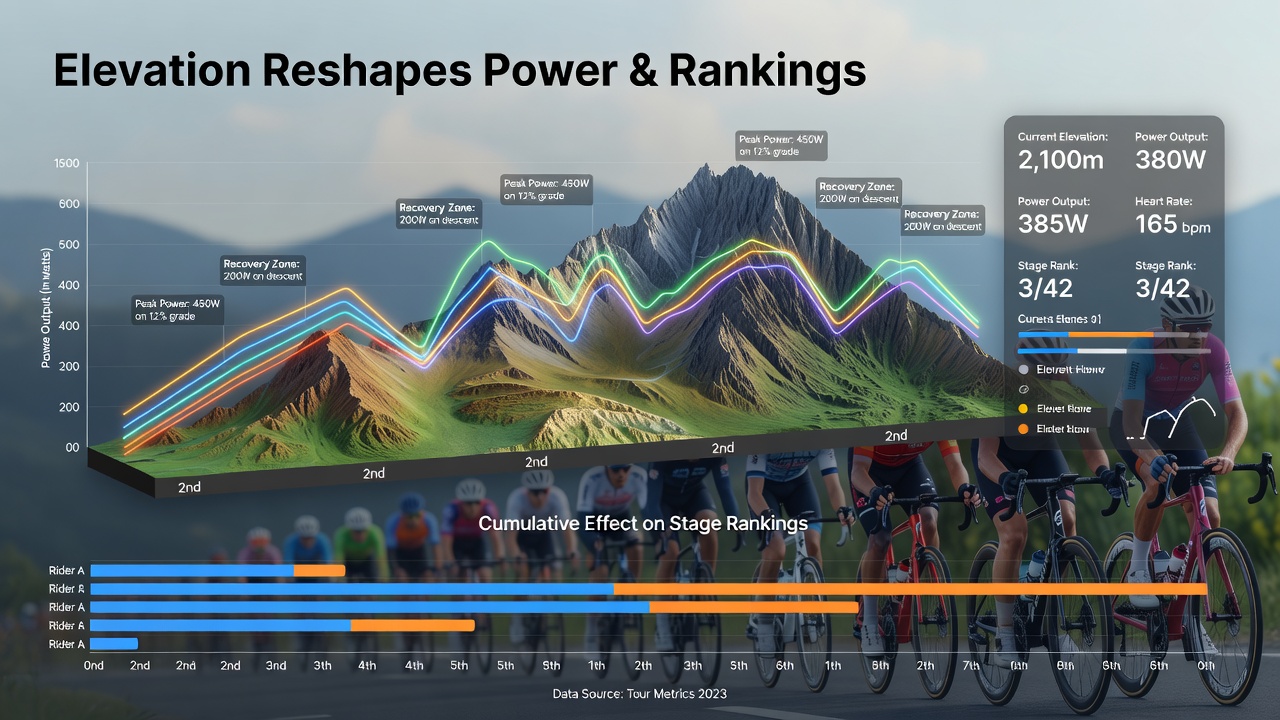
Analysis of stage results from the 2024 and 2025 editions of major tours shows that time gaps between top-10 general-classification contenders widened by an average of 45 seconds on mountain finishes compared with rolling stages, and power-file reviews confirm that the leaders maintained higher normalized power outputs while rivals dropped back when gradients exceeded 7 percent. One study published through academic channels linked these patterns to differences in body mass and climbing efficiency rather than raw wattage alone.
According to data compiled by the Australian Sports Commission, elevation profiles in September 2026 events are expected to include more categorized climbs above 2,000 meters, which will further emphasize recovery between successive mountain days. Riders who recover quickly from prior efforts preserve their ability to produce consistent power on later stages, whereas accumulated fatigue reduces sustainable output by 10 to 15 percent in subsequent ascents.
Rankings and Tactical Adjustments
Stage rankings shift when elevation rewards specialists who optimize power-to-weight ratios, and general-classification contenders often lose or gain minutes on single climbs because small differences in sustained output compound over several kilometers. Breakaways containing strong climbers frequently stay clear on mountain stages because the peloton cannot chase at the required wattage without exhausting key domestiques before the final ascent.
Teams adjust tactics by positioning lighter climbers near the front on valley approaches, and this positioning allows them to respond immediately when attacks occur on the lower slopes. Data from past races indicate that attacks launched between 3 and 5 kilometers from summits produce larger time gaps than those begun at the base, because opponents have less distance to close the deficit at reduced power levels.
Conclusion
Elevation profiles continue to dictate power requirements and reorder stage rankings in mountain tours because they amplify the importance of body composition, aerobic capacity, and tactical timing. Future events scheduled through September 2026 will likely reinforce these patterns as course designers incorporate more high-gradient sections that separate riders by physiological strengths rather than equipment or drafting advantages alone.